
Targeted communities experience high levels of chronic and acute food insecurity and malnutrition as well as droughts and other shocks. The two counties of Isiolo and Marsabit are highly dependent on pastoralist livelihoods that are under increasing pressure from climate change, economic shifts, conflict, and governance issues.
Populations affected and main drivers of undernutrition
From late 2020 to early 2023, five consecutive failed rainy seasons led to severe drought and humanitarian crisis. Across Kenya’s north, families lost their most important assets: 2.6 million animals died at an estimated economic cost of more than $1.5 billion. Drought worsened water insecurity, resulting in spikes in disease among young children. The after-effects of drought continue to depress livestock birth rates and milk production (a key driver of child malnutrition). High food and fuel costs, driven by global, regional and local factors, continue to pose a challenge, with maize prices across the arid and semi-arid lands (ASALs) of northern Kenya reaching 18-97% above five-year averages in July 2023. This has resulted in levels of global acute malnutrition among young children rising to well above those defined as ‘emergency’ by the World Health Organization.
Response delivered
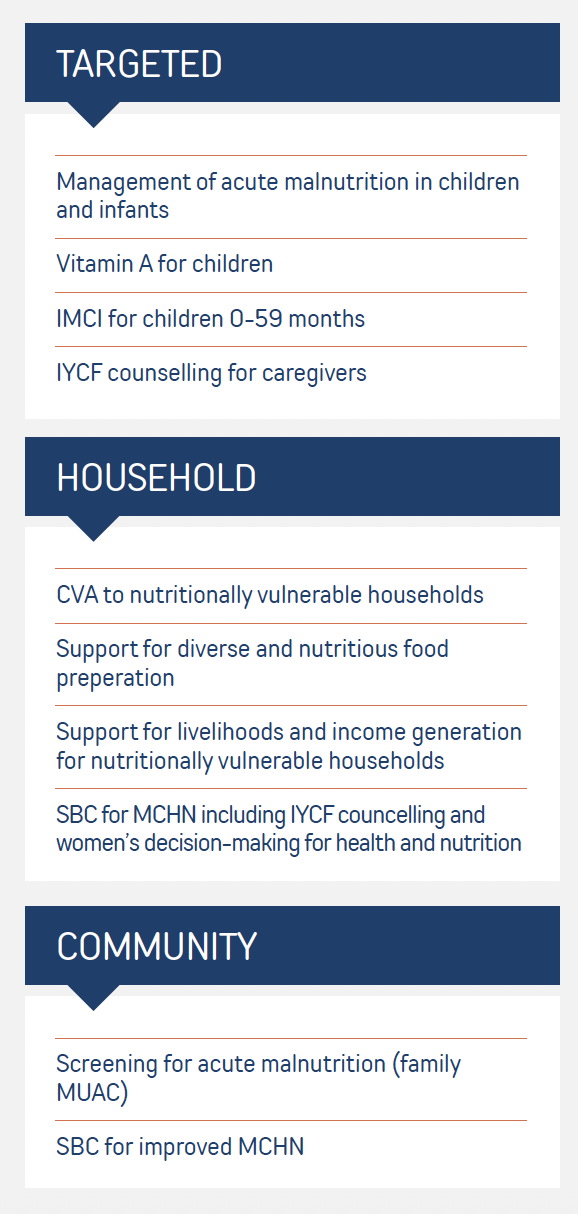
The graduation approach70 builds upon the tested and researched core graduation work of USAID Nawiri Village Enterprise and BOMA’s interventions, respectively, while incorporating adaptations to address the immediate, underlying and basic causes of persistent acute malnutrition (PAM). The approach enrols ultra-poor households whose children and PBW are most vulnerable to malnutrition. Core components of support for targeted households includes asset transfer, group businesses, community-based savings groups, mentorship and coaching, training, and consumption support cash transfers, all delivered over a 5 year period. These activities have provided important platforms on which to layer other nutrition-sensitive and nutrition-specific project components, including additional livelihoods training, support for nutritious food production, health interventions such as deworming and vitamin A supplementation, SBC activities, health and nutrition education, and market systems activities
Early results
- 83% of the participants achieved four of the graduation criteria71 and successfully graduated.
- 88% of businesses achieved 25% higher productive asset/ value than the original cash transfer.
- 92% of households eat at least two meals a day, from 86.3% at baseline.
- Women involved in decision-making on family planning, purchasing of food, sending their children to school, and acquiring assets have doubled.
- Minimum dietary diversity (MDD) among children in participating households increased from 24% to 39%.
- Awareness of nutrition and nutritive food preparation practices increased among project participants.
- 83% received agri-nutrition training and 90% utilised the training.
- Use of modern healthcare and referrals to health centers increased.
- 72% received training in kitchen gardening, with 26% adopting kitchen gardening for personal consumption and sale.
Learning for nutrition
Support for improved nutrition practices is essential. This has helped participants understand different food groups and their nutritional benefits and strive to have different food categories in their meals as well as practice food preparation techniques that minimise the loss of nutrients during the cooking process. “Our knowledge on food preparation has changed because there are foods we do know how to prepare like vegetables and chapati, which we did not know how to prepare before” (FGD participant). Lactating mothers are now also exclusively breastfeeding their children for up to 6 months.
Training on agri-nutrition was highly correlated with improved diet diversity. Almost 90% of the households who achieved minimum diet diversity (MDD) for their children received training in agri-nutrition. Harvests from the kitchen gardens were used for both household consumption and for sale to the community, generating an income of up to KES 5,000 per month. Demonstration plots were key in helping the participants learn hands-on skills in setting up and managing kitchen gardens. There was also a high correlation between achieving child MDD and having kitchen gardens. Almost 80% of households who achieved MDD for their children had kitchen gardens. Affordable water-conserving technologies and wastewater recycling training could help drive the adoption of kitchen gardens.
Supporting women’s decision making in households improves nutrition practices. In pastoral communities, decision-making is traditionally the responsibility of male household members. The project integrated life skills training and a household approach to encourage the inclusion of women’s voices to influence the decision-making process. Women’s involvement in decision-making improved, particularly in matters related to children’s education, family planning, and food purchases. The enhanced decision-making of women in food procurement contributed to an increase
References
69 This case study is based on the learning brief: REAP for Nutrition. Impact and Learning Report: Lishe Bora authored by BOMA in Kenya, Oct 2023.
70 The Graduation Approach used by USAID Nawiri consists of a sequenced, time-bound package of interventions intended to “graduate” poor households to sustainable livelihoods and to reduce risk of malnutrition
71 Graduation criteria included: household food security (no child going to bed without an evening meal and participants eat at least two meals a day), sustainable livelihoods (businesses with 25% higher productive asset/value than original cash transfer and participants with multiple income sources), shock preparedness (participants reported increased access to credit and participants meet savings target of a minimum of KES 8,000) & human capital investment (households with school-aged girl child attending primary school and female participants with an increased role in household decision-making).