
Definition
The definition of ‘humanitarian’ contexts can be difficult to define but has recently been described as a context affected by “an event or series of events that represents a critical threat to the health, safety, security or well–being of a community or other large group of people, usually over a wide area.”12
This definition acknowledges that humanitarian emergencies may be caused by multiple concurrent events, it does not impose a time restriction on the resolution of the emergency, and it encompasses the health and well–being of communities. Not all humanitarian contexts are covered by the ‘humanitarian system’ nor by ‘international humanitarian action’. It is important to note, therefore, that for the successful delivery of actions that aim to prevent undernutrition there is no single system or platform to leverage that will reach all those in need in humanitarian emergencies. It can be helpful to think about responses to humanitarian emergencies in two main categories:
- International humanitarian action (led by the IASC cluster system including the nutrition cluster).
Domestic crisis management (government–led).
These two categories are not mutually exclusive. For example, in many countries, government representatives are central to the coordination of the cluster system, and in other countries UN and international agencies may offer specific technical support within a government–led domestic crisis management approach. However, given the fact that the two broad categories have different funding mechanisms, and often different operational approaches, it can be helpful to bear these broad distinctions in mind when thinking about the design of a multisectoral response for the prevention of undernutrition.13
Given this tool is designed to support the prevention of undernutrition, it is particularly relevant to the stages of crisis before levels of food insecurity, malnutrition and mortality get too high. There are several global and country–led approaches in use to help define and classify crisis according to levels of severity and need:
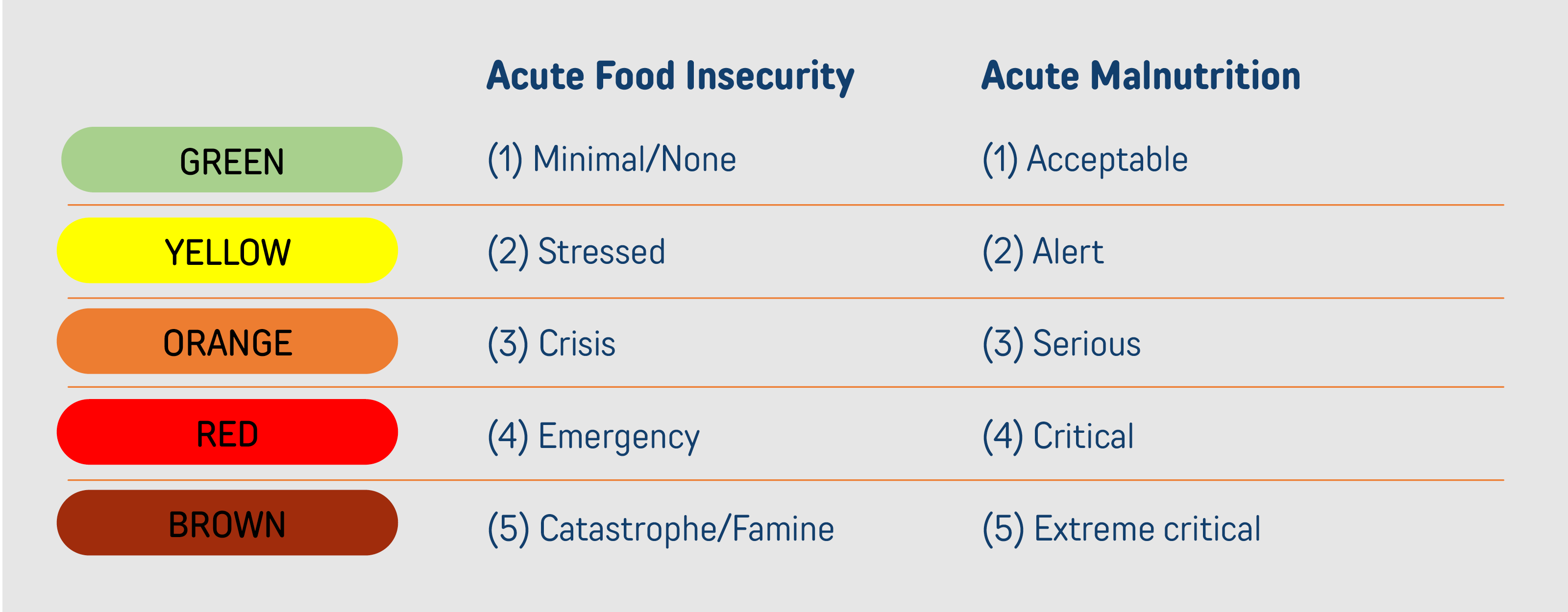
- The integrated phase classification (IPC) defines these stages for Acute Food Insecurity and for Acute Malnutrition with the following 5 severity phases.14 It is in phases 2 and 3 (and in certain circumstances phase 4) of this classification when preventive actions have the best chance of stabilising a deteriorating situation.
- Vulnerability Analysis and Mapping (VAM) is a framework used by the World Food Programme (WFP) for assessing food security, vulnerability and the impact of shocks. It uses geographic information systems (GIS) and household surveys to map vulnerabilities and to assess factors like market access, climate risks and nutrition outcomes. It does not use fixed phases like the IPC but rather develops tailored classifications based on context–specific vulnerability and food security conditions. Outputs help design targeted food assistance programmes.
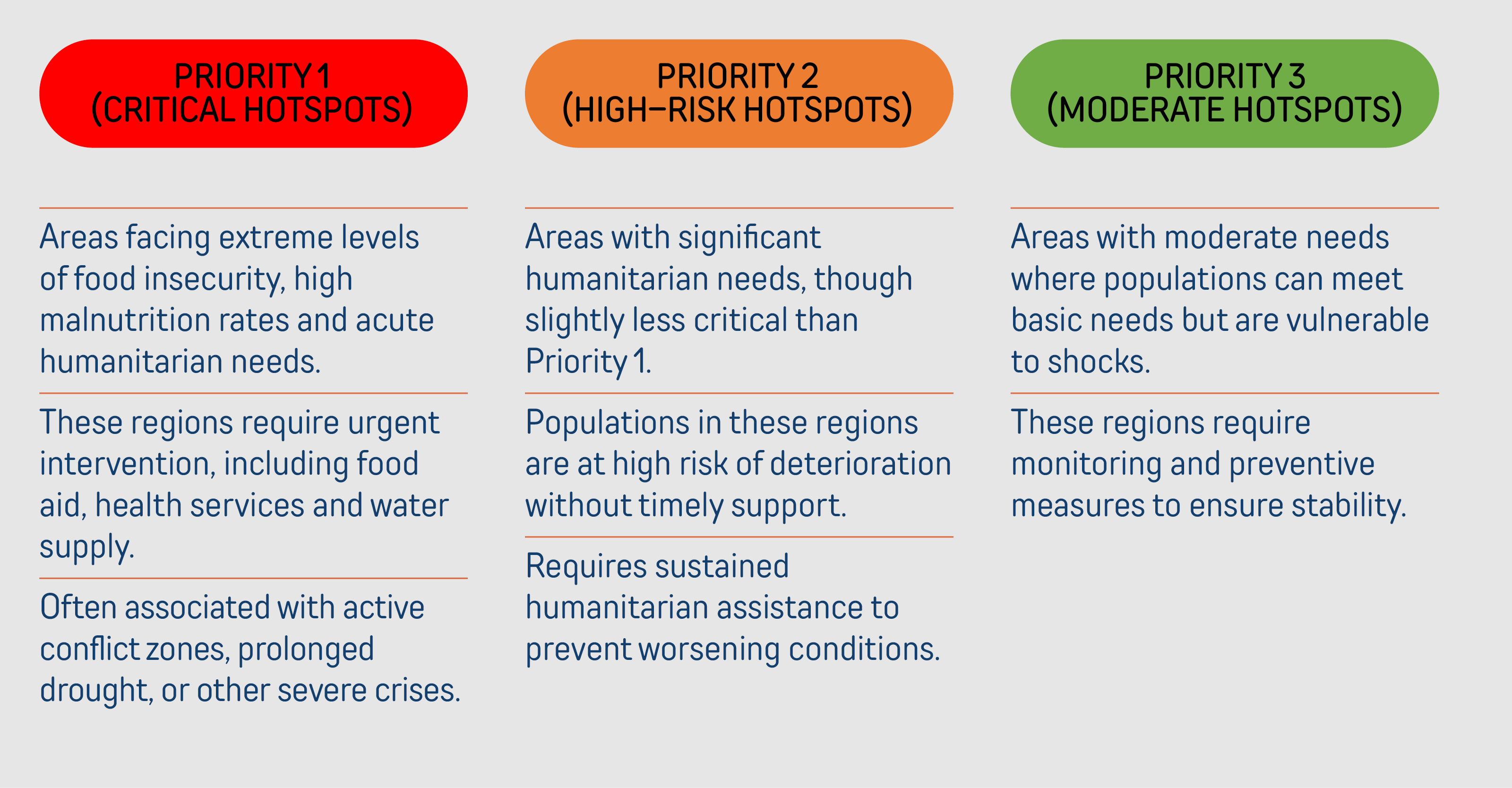
In Ethiopia, the "hotspot classification" refers to the identification and categorisation of areas facing severe food insecurity and humanitarian needs.15 This system is used by government agencies and humanitarian organisations to prioritise and target interventions effectively. The classification is based on indicators such as food availability, malnutrition rates, water access and the impact of conflict, drought, or other shocks. It is in priority 2 and 3 categories of this classification when preventive actions have the best chance of stabilising a deteriorating situation.
Other systems in use include:
- Cadre Harmonisé (CH) is a framework similar to IPC, it is used primarily in West Africa to assess food insecurity and vulnerability. It harmonises methodologies and reporting across countries.
- Famine Early Warning Systems Network (FEWS NET) provides food security analysis and projections to prevent famine and inform humanitarian action.
- Early Warning Systems like FAO’s Global Information and Early Warning System (GIEWS) and regional initiatives track food insecurity risks and issue alerts for emerging crises to trigger timely interventions.
- Other custom–developed national systems including India’s Integrated Child Development Services (ICDS), which incorporates nutrition surveillance for at–risk populations and Kenya’s National Drought Management Authority (NDMA), which monitors food security and drought impacts.
Whilst these classifications are not used or relevant in all humanitarian and food insecure contexts the same principle will apply, ie, that a multisectoral preventive response has the best chance of success before levels of acute malnutrition, food insecurity, disease and mortality are rising quickly.
References
13 ibid
14 IPC Overview and Classification System | IPC - Integrated Food Security Phase Classification (no date) (Accessed: 27 February 2024).
15 Guidelines for Analysis and Identification of Areas of Concern (Hot Spots), Addis Ababa 2019