
It focuses on tackling various interconnected factors by uniting different sectors – such as health, nutrition, education and social protection – to work collaboratively in designated locations. Notably, convergence exists on a continuum and evolves over time.50 This is commonly represented by terms such as integration, collaboration, coordination and cooperation, which are often used interchangeably to describe different stages along the continuum.51 This variation should be considered when designing, implementing and evaluating multisectoral convergence.
For a multisectoral nutrition response "effective convergence" goes beyond enhanced coordination and collaboration and should involve successfully delivering nutrition–related programmes from relevant sectors to address the key factors contributing to poor nutrition for the same household, woman and child during the critical first 1,000 days, from conception to the child’s second birthday.52, 53 This requires collaboration and coordination at multiple levels but particularly around the targeting of interventions both geographically and at household and individual level.
Why is convergence important for the prevention of undernutrition in humanitarian contexts?
Some of the reasons why converging interventions for vulnerable households and communities is especially necessary for the prevention of undernutrition in humanitarian contexts include:
- Multifaceted nature of drivers of undernutrition: The drivers of undernutrition are known to be diverse, interconnected and highly contextual with social variations54 and there is increasing evidence and recognition that multi–factorial causation of undernutrition is best addressed with multi–sectoral interventions (see section on the rationale for a multisectoral approach to preventing undernutrition). This requires convergent action by multiple sectors and stakeholders to align objectives and target groups across policies and programmes.
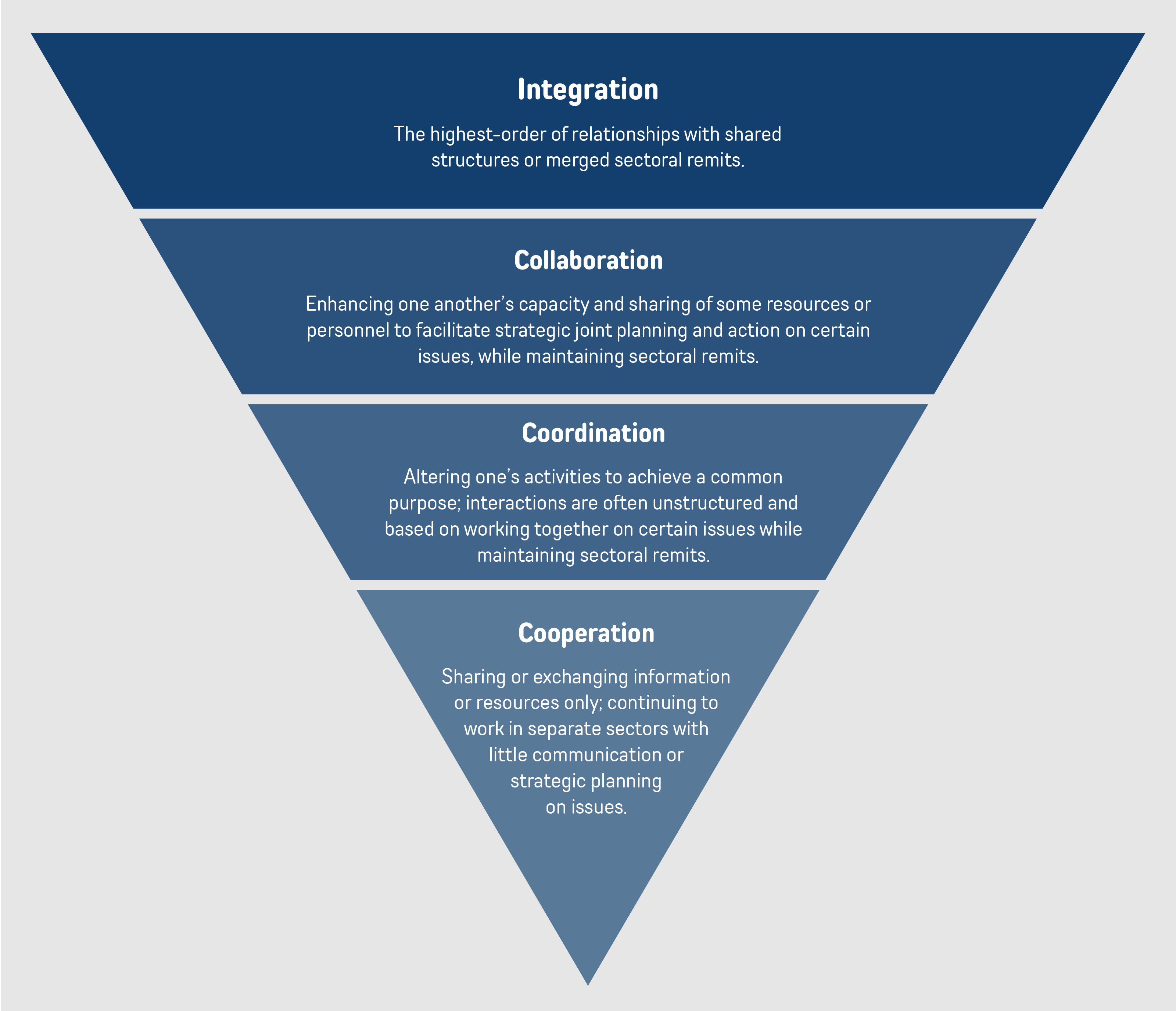
Figure 4: Degrees of Convergence
- Increased coordination and efficiency: Convergence of resources and expertise from different sectors at the household/community level can help foster collaboration among various stakeholders, including governments, NGOs, and community organisations. This coordinated approach reduces duplication of effort, enhances the efficiency of resource use and leads to more cohesive strategies for tackling undernutrition in emergencies. This is particularly vital in humanitarian contexts, where resources may be limited.55
- Strengthening of household and community nutrition resilience: Implementing multiple interventions around vulnerable households helps to build community resilience by empowering families with the knowledge, resources and skills necessary to withstand shocks such as natural disasters or economic crises.56 This resilience is critical in emergency contexts, where the risk of undernutrition is heightened. It can also help the households/communities develop diverse coping strategies and enhanced adaptability through sequencing, layering and integration of intervention strategies that provide immediate relief and promote long–term recovery.57 This process also provides opportunities for community engagement/ participation which helps strengthen social networks and support systems. These networks play a crucial role during emergencies, as they facilitate resource sharing and emotional support, enhancing resilience.58
- Integrated monitoring, evaluation and adaptive learning: A convergent approach allows for integrated monitoring and evaluation of interventions, enabling stakeholders to track progress more effectively. This integrated data collection can provide valuable insights into what works and what doesn't, what needs to be adapted and facilitate timely adjustments to programmes and policies.59
Key Conditions and considerations
- Alignment on shared priorities, clear roles and leadership, regularity of participation and actions across all levels, as well as sectoral accountability for convergence is essential. Strong collaboration is facilitated by close interpersonal communication and mutual understanding of responsibilities.
- Focus should be on providing all essential services to the mother–child dyads through mechanisms that promote a continuum of care, rather than relying on siloed sector– specific and service–driven delivery processes.
- Areas of potential convergence (where practices and principles of nutrition and other sectors are complementary and synergistic) and of potential tension (where these are at odds) should be considered and discussed from the outset. These include how sectors determine their targeted beneficiaries, define vulnerability, design the intervention approaches as well as sectoral monitoring and evaluation mechanisms.
- Undertake in–depth needs analysis using diverse methods that promote participatory identification of context specific gaps and existing capacities, eg, focus should be on identifying local opportunities and needs in collaboration with the communities to promote ownership from the outset.
- Mutual sharing of data to inform planning and adaptations is important: routine analysis/review of data on coverage of individual and convergent interventions to identify learning, gaps and adaptations needed.
- Leverage existing multisectoral coordination platforms to support the convergence of interventions, as creating new structures often adds to the burden on teams and strains limited resources.
Tools and Guidance
References
49 Technical note on convergent programming.
50 Kim, S.S., Avula, R., Ved, R. et al. (2017). Understanding the role of intersectoral convergence in the delivery of essential maternal and child nutrition interventions in Odisha, India: a qualitative study .
51 Garrett J, Natalicchio M. (2011). Working Multisectorally in Nutrition: Principles, Practices, and Case Studies. Washington, D.C.; 2011.
53 Dash, Antaryami, Shahab Ali Siddiqui, Debashmita Bhaumik, and Antara Dhargupta. (2022). “Assessing the Multi-Sectoral Convergence of Interventions Impacting Nutrition at the Household Level: Lessons from Sundarbans, West Bengal, India
54 Young, H. (2020) A conceptual framework for addressing acute malnutrition in Africa’s drylands. Boston, USA: Feinstein International Center.
55 Smith, L. C., & Haddad, L. J. (2015). Reducing child undernutrition: Past drivers and priorities for the post–MDG era. World Development, 68, 180–204. DOI: 10.1016/j.worlddev.2014.11.013.
56 Evers, S., & Ruel, M. T. (2016). Resilience and nutrition: A framework for action. International Food Policy Research Institute (IFPRI).
57 The World Bank. (2013). Building Resilience: Integrating Climate and Disaster Risk into Development.
58 Pellaud, J., & Weiss, C. (2021). Social Networks and Community Resilience: A Practical Approach for Disaster Risk Reduction. International Journal of Disaster Risk Reduction, 60, 102326.
59 Grellety, E., & Golden, M. H. N. (2018). The importance of multiple interventions in the prevention and treatment of malnutrition. The Lancet Global Health, 6(3), e294-e295. DOI: 10.1016/S2214-109X(18)30045-7.