
with the main objective to prevent famine and mitigate hunger by increasing access to food and other lifesaving supplies and services, increasing purchasing power and advocating for measures to bring economic stability. A critical component of the strategy was to secure and increase the buy-in of an ever-growing number of key actors at all levels.
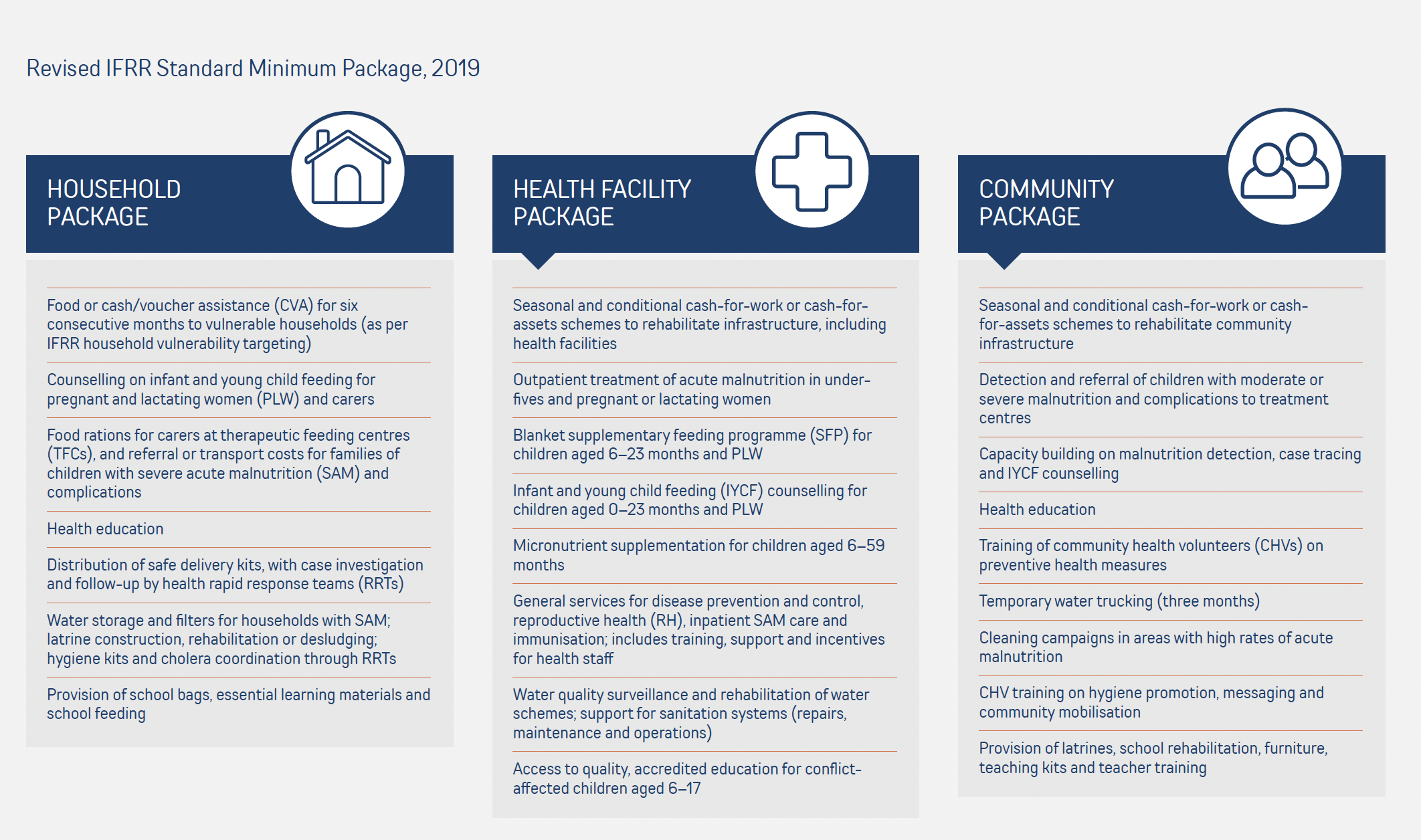
Operational guidelines for IFRR programming were agreed by the four clusters, prioritising the most vulnerable communities living in 107 districts of Yemen, through the analysis of available data and consultation with experts and stakeholders working at district-level. The approach built on joint geographical convergence, an agreed package of multisectoral services, joint beneficiary selection criteria and a joint monitoring, evaluation and reporting framework.
Coordination, targeting and convergence
The IFRR package was coordinated at both national and sub-national levels. National–level coordination involved monthly meetings between cluster coordinators and the Office of Coordination of Humanitarian Affairs (OCHA) to integrate IFRR into the humanitarian response. Sub-national coordinators oversaw district-level implementation, working with local partners to identify vulnerable areas and use primary health care facilities for service delivery. A gap mapping exercise identified health facilities that needed capacity strengthening. Government engagement was at a technical (service delivery) level through line ministries and vulnerable households were selected based on agreed criteria, considering nutrition, food security and health vulnerability. The full IFRR package is displayed on the following page.
Mobilisation of resources
Joint advocacy and fundraising efforts to secure funding to support IFRR was done by donors and the humanitarian country team (HCT). All clusters were involved in coordination and advocacy at national and sub-national level, which facilitated the creation of an enabling environment to sustain and further promote the approach. Pooled funds allocated ($56M) to implement the IFRR strategy and partner funding was secured for the employment of a dedicated coordinator and a team to work at sub–national level.
Successes, challenges and missed opportunities
There were several successes of the IFRR programme including:
- Enhanced coordination and integrated programming for the emergency response facilitated collaboration among international actors such as the IASC clusters, leading to the development of an integrated minimum package of interventions for priority districts. This approach ensured that food security, nutrition, health and WASH needs were addressed collectively in the minimum package and that services converged on the same populations.
- Improved and coordinated communication linked to the IFRR programme and strategy which fostered adherence and joint advocacy and fundraising to secure donor support for the humanitarian response.
- Increased access to services prioritised by the minimum package.
- Some capacity building and integration into health services for nutrition including the training of health workers for nutrition assessment and the integration of nutrition surveillance into routine maternal, newborn, and child health services.
However, key challenges and missed opportunities have been recognised, particularly linked to governance and coordination. These have limited the IFRR’s ability to reinforce the humanitarian development peace nexus (HDPN) and to create sustainable rather than just short–term solutions:
- Limited engagement with the SUN Movement: Yemen joined the SUN Movement in 2012, committing to a multi-sectoral approach to improve nutrition. In 2014 the national plan for all humanitarian, development and peace actions across sectors that contribute to improved nutrition (MSNAP) was launched. However, during the implementation of the IFRR strategy, there was insufficient integration with SUN's frameworks and resources nor with the national governance of the MSNAP. This gap resulted in missed opportunities for leveraging and strengthening existing national platforms for coordination, technical assistance, and monitoring that could have strengthened understanding of the IFRR's impacts and improved longer-term effectiveness.
- Insufficient national ownership and leadership: The IFRR strategy was primarily driven by international clusters and organisations, with limited involvement from national and local government entities. This approach led to a lack of national ownership, reducing the sustainability and, in some instances, cultural appropriateness of interventions. Enhanced collaboration with Yemeni authorities could have facilitated more effective strategy implementation and resource allocation.
- Inadequate capacity building: There was a shortfall in efforts to build the capacity of local institutions and communities to manage and sustain nutrition programs. By not focusing on empowering local stakeholders, the strategy missed the chance to improve long–term resilience and self–reliance in addressing nutrition challenges.
Conclusion
Key successes of the IFRR included enhanced coordination for the humanitarian response, improved access to essential services, joint advocacy for funding, and some integration of nutrition services into health systems. However, challenges such as limited engagement with the SUN Movement and the Multi-Sectoral Nutrition Action Plan (MSNAP), insufficient national ownership, and inadequate capacity–building hindered long–term sustainability. The strategy was largely driven by international actors, missing opportunities for local leadership and for strengthening national strategy, plans and implementation.
In 2024, the SUN Yemen Secretariat, which serves as the government’s focal point for the Global SUN Movement, along with support from the UN and various donors, has updated the Yemen MSNAP. This update underscores the importance of a coordinated, evidence-based approach to addressing malnutrition. By integrating nutrition-focused efforts across sectors and leveraging the Geographical Prioritization Tool (GPT), the MSNAP ensures that resources are directed toward high–impact interventions in priority districts. The alignment of humanitarian and development efforts within a cohesive framework enhances efficiency, reduces duplication and maximises coverage. With national and global targets guiding its implementation, the MSNAP serves as a strategic roadmap for sustainable nutrition improvements, fostering resilience and long–term development in Yemen’s most vulnerable communities.
References
74 This case study was provided by Scaling–Up Nutrition Secretariat (SUN–YEMEN), Ministry of Planning & International Cooperation, Yemen